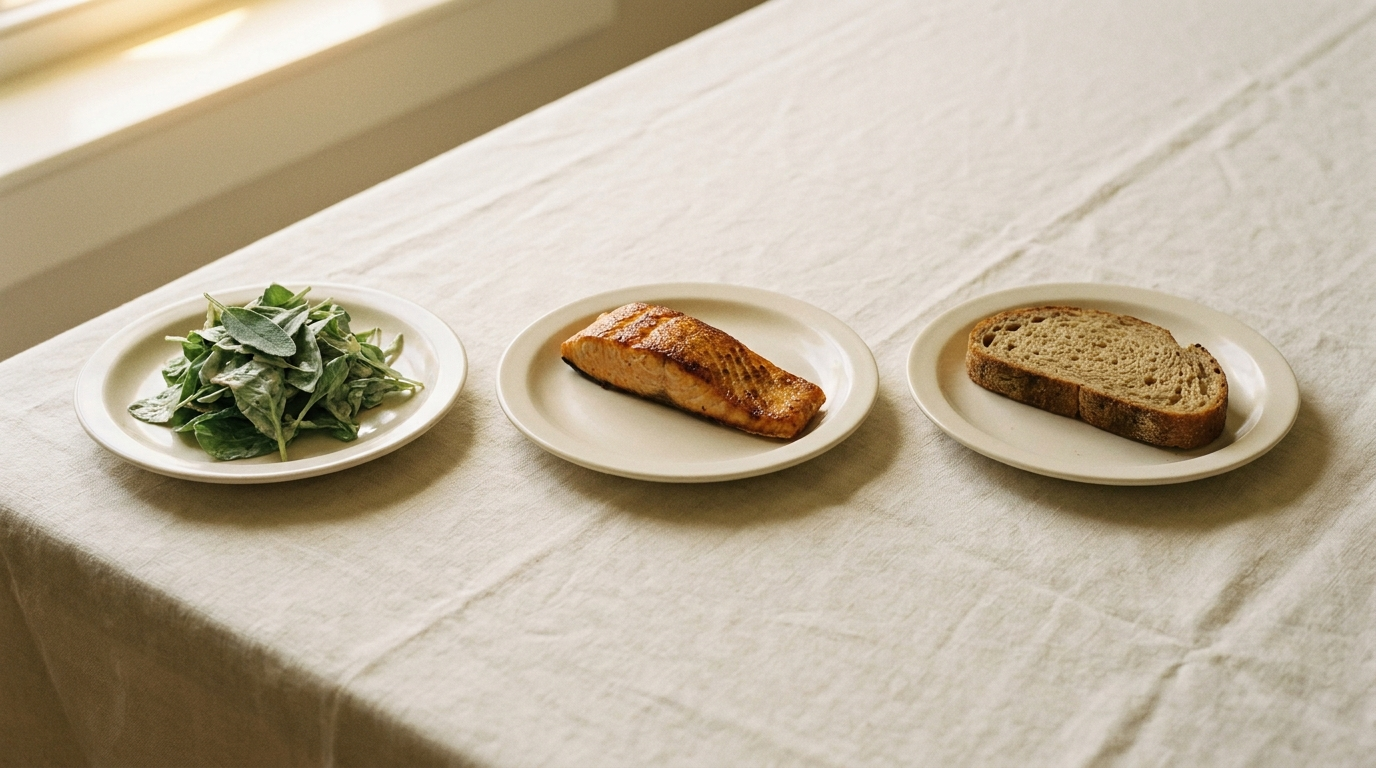
The food-sequencing hack that drops glucose 29–54%.
Same meal, same calories, same macros. Eat the components in a different order and your postprandial glucose spike drops by roughly 29–54%. This is one of the most well-replicated, least-discussed findings in metabolic research.
No supplement. No fast. No calorie cut. Just sequence.
Shukla 2015 — the landmark trial
Shukla et al. (2015, Diabetes Care) tested 11 subjects with type 2 diabetes. Identical meal — bread, chicken, salad — eaten two ways: carbs first, or protein and vegetables first with carbs last.
The protein-and-vegetables-first group showed: 29% lower glucose at 30 minutes, 37% lower at 60 minutes, 17% lower at 120 minutes. Insulin levels dropped ~50%. Same food. Different order.
Shukla's follow-up (2019, Diabetes, Obesity & Metabolism) repeated the experiment in prediabetic subjects and found over 40% reduction in incremental glucose peak.
Why it works — three mechanisms
- Slower gastric emptying. Fats and protein slow the passage of food from the stomach to the small intestine, which flattens the glucose curve.
- GLP-1 release. Protein and vegetables trigger GLP-1 secretion before the carbs arrive. GLP-1 improves insulin response and suppresses glucagon (Baggio & Drucker, 2007).
- Fiber matrix. Vegetables eaten first form a physical barrier that slows carbohydrate absorption in the small intestine.
The honest caveats
Shah et al. (2019, Journal of Clinical Endocrinology & Metabolism) showed healthy adults spend roughly 30 minutes per day above 140 mg/dL — brief postprandial excursions are normal physiology, not pathology. Food sequencing is a lever for people with metabolic dysfunction (T2D, prediabetes, insulin resistance). For a healthy 25-year-old, the absolute benefit is smaller.
How to actually do it
One rule: at every meal that has carbohydrates, eat the vegetables and protein first. That is the whole protocol.
- Sandwich lunch → eat the side salad before the bread half.
- Pasta dinner → eat the Caesar or roasted vegetables before the pasta.
- Rice bowl → eat the protein and greens before the rice.
- Breakfast → eggs and greens before toast or oatmeal.
What's safe to believe vs. what to flag
- Protein + vegetables before carbs drops post-meal glucose 29–54% in diabetic subjects and >40% in prediabetic subjects (Shukla 2015, 2019).
- Effect is replicated across multiple trials and populations.
- Mechanism is grounded in GLP-1 release and gastric emptying — not mystical.
- Claims that healthy adults need to prevent "glucose spikes" of 140 mg/dL — brief postprandial excursions are normal physiology.
- Extrapolating the 29–54% number to healthy populations — effect size is smaller without metabolic dysfunction.
The honest bottom line
Free. Instant. Compound-able. Protein and vegetables first — at every meal with carbs. If you have metabolic dysfunction or insulin resistance, this may be the highest-leverage single habit change you can make outside of fasting itself.
Sources
- Shukla et al. (2015), Diabetes Care — type 2 diabetes. PubMed 26106234
- Shukla et al. (2019), Diabetes, Obesity & Metabolism — prediabetes. PubMed 30101510
- Imai et al. (2014), Journal of Clinical Biochemistry & Nutrition — food-order effect in type 2 diabetes. PubMed 24426184
- Shah et al. (2019), JCEM — ~30 min/day above 140 mg/dL in healthy adults. PubMed 31127824
- Baggio & Drucker (2007), Gastroenterology — GLP-1 physiology. PubMed 17498508
 By Brian Schultz — Founder